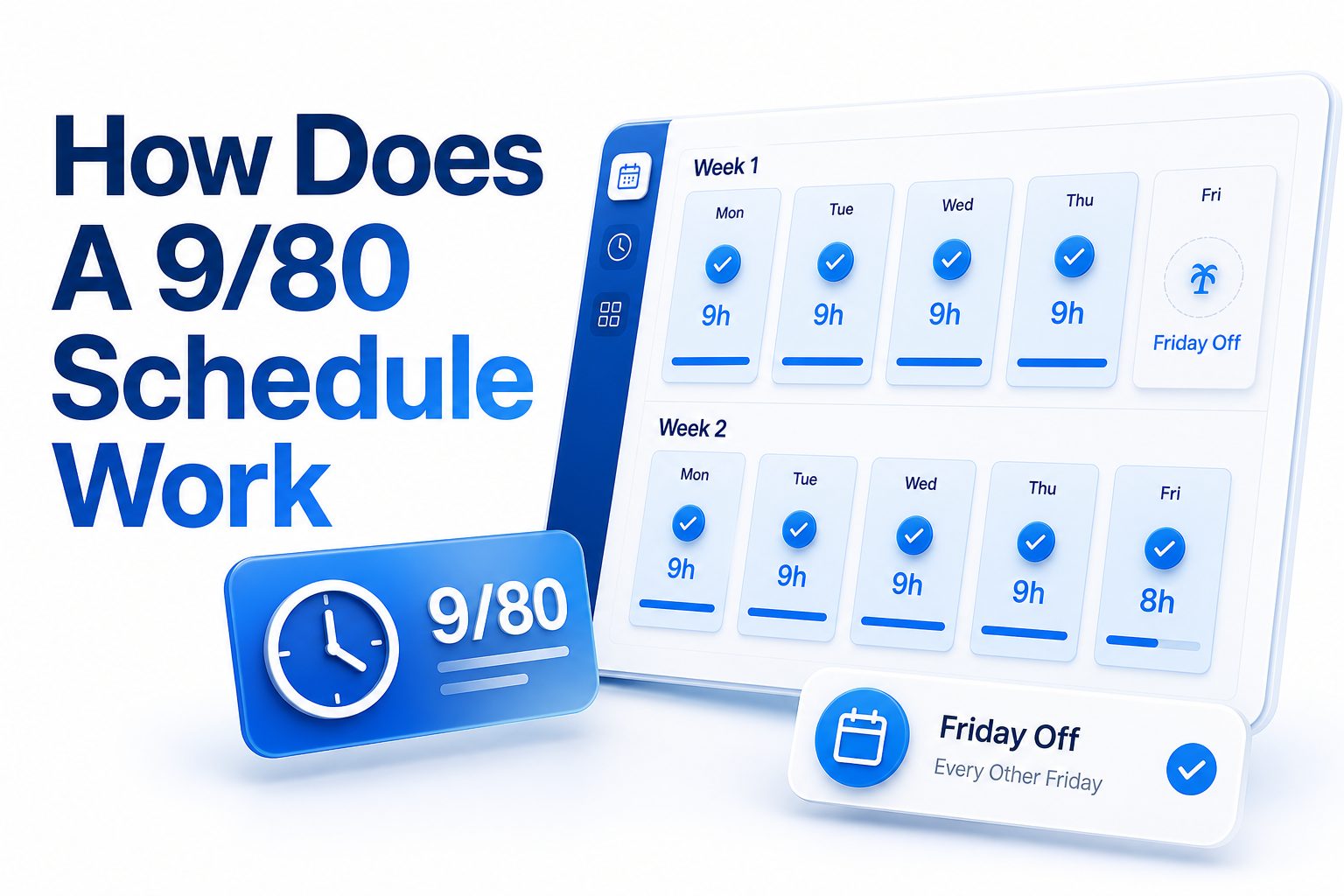
A 9/80 work schedule is one of the most popular alternatives to the traditional five-day, 40-hour workweek. Instead of working eight hours a day, Monday through Friday, employees work 80 hours across nine days and receive one extra day off every two weeks. That usually means a three-day weekend every other week.
If you have wondered how does a 9/80 schedule work, the idea is fairly simple: employees work slightly longer days in exchange for more personal time. For many teams, this structure improves work-life balance without reducing total hours or productivity. It can also help employers attract talent, reduce burnout, and create a more flexible workplace.
Still, a 9/80 schedule needs careful planning. Payroll, overtime rules, staffing coverage, customer needs, and employee preferences all matter. When handled well, it can be a practical scheduling model for office teams, technical staff, government workers, and project-based roles.
How a 9/80 Schedule Is Structured
A 9/80 schedule divides 80 working hours across nine workdays instead of ten. Employees typically work eight nine-hour days, one eight-hour day, and receive one weekday off during a two-week cycle. The day off is often every other Friday, but employers can choose another day.
The most common version starts with four nine-hour days from Monday to Thursday, then one eight-hour Friday. The next week includes four nine-hour days from Monday to Thursday, followed by Friday off. This keeps total hours at 80 while giving employees longer uninterrupted weekends.
A Simple 9/80 Work Schedule Example
A typical 9/80 example may look like this: Monday through Thursday, employees work from 7:30 a.m. to 5:30 p.m. with a one-hour lunch. On the first Friday, they work eight hours. On the second Friday, they do not work at all.
The exact start and end times can vary. Some companies use 8:00 a.m. to 6:00 p.m., while others shift hours earlier or later. The key is that the schedule must add up correctly and align with payroll rules, coverage needs, and state labor requirements.
Key Facts About a 9/80 Schedule
- Employees work 80 hours over nine workdays.
- The schedule usually creates one extra day off every two weeks.
- Most plans use eight nine-hour days and one eight-hour day.
- The off day is commonly every other Friday.
- Payroll weeks may need to be adjusted to avoid overtime issues.
- The schedule works best when coverage and communication are planned clearly.
Why Companies Use a 9/80 Schedule
Many employers adopt a 9/80 schedule because it supports retention and employee satisfaction without cutting total work hours. Employees gain predictable personal time, which can reduce stress and help them manage appointments, errands, family responsibilities, or rest.
Companies also benefit from fewer interruptions during the workweek. Longer days can support deeper focus, especially for project-based roles. When employees know they have a three-day weekend coming, morale often improves and time-off requests may decrease.
Employee Benefits of a 9/80 Workweek
For employees, the biggest advantage is the regular extra day off. A weekday away from work can be more useful than a weekend day because banks, medical offices, schools, and government services are open. That makes personal planning easier.
The schedule can also reduce commuting costs and time. Employees who commute long distances may save fuel, parking fees, transit costs, and mental energy. Over a year, 26 extra weekdays off can feel like a meaningful improvement in quality of life.
Common Benefits at a Glance
Benefit | Why It Matters
Extra day off | Gives employees more personal time every other week
Same total hours | Keeps pay and workload consistent
Fewer commutes | Reduces travel time and transportation costs
Better focus | Longer days may support deeper work blocks
Stronger retention | Flexible schedules can help keep experienced employees
Lower burnout risk | Predictable recovery time can improve morale
Employer Advantages of a 9/80 Schedule
Employers often see a 9/80 schedule as a practical way to offer flexibility without moving to a four-day workweek. Since employees still work 80 hours per pay cycle, the business preserves labor capacity while improving the employee experience.
This schedule can also strengthen recruitment. Many candidates compare benefits beyond salary, and flexible work arrangements can influence job decisions. A well-run 9/80 policy can make a company more attractive in competitive labor markets.
Potential Challenges to Plan For
The main challenge is coverage. If many employees take the same Friday off, customers, vendors, or internal teams may struggle to get support. Some businesses solve this by splitting employees into alternating groups so the office remains staffed every Friday.
Another challenge is fatigue. Nine-hour days can feel long, especially for roles that require constant meetings, phone coverage, physical labor, or high concentration. Managers should monitor workloads, meeting habits, and employee feedback before making the schedule permanent.
9/80 Schedule Planning Checklist
- Confirm state and local overtime laws before launch.
- Decide whether everyone has the same off day or rotating off days.
- Review customer service, sales, and operational coverage needs.
- Update payroll settings before the first pay cycle.
- Create clear written rules for holidays, PTO, and sick leave.
- Train managers on scheduling expectations and exceptions.
- Run a pilot before adopting the policy company-wide.
How Payroll Works With a 9/80 Schedule
Payroll is one of the most important parts of a 9/80 schedule. Because employees work more than eight hours on many days, employers must confirm whether daily overtime rules apply in their jurisdiction. Federal rules differ from some state rules.
Many employers structure the workweek so the eight-hour Friday is split between two workweeks. This can help keep each official workweek at 40 hours. Payroll setup should be reviewed carefully with HR, finance, or legal counsel before implementation.
Overtime Considerations for Employers
Overtime rules can be tricky because a 9/80 schedule does not automatically eliminate overtime exposure. Nonexempt employees must be paid according to applicable wage and hour laws. In some places, daily overtime may apply after a certain number of hours.
Employers should document the official workweek, scheduled hours, meal periods, and approval process for extra work. If employees answer emails or finish tasks on their scheduled day off, that time may need to be tracked and paid properly.
Best Practices for 9/80 Payroll Setup
Tip | Practical Action
Define the workweek | Set a clear payroll workweek before launch
Track all hours | Require accurate timekeeping for nonexempt employees
Clarify off-day work | Explain when work on the off day is allowed
Review holidays | Decide how holiday pay applies during nine-hour days
Audit early cycles | Check the first few payroll runs for errors
Document policies | Keep written rules available to employees and managers
Who Is a Good Fit for a 9/80 Schedule
A 9/80 schedule often works well for office employees, engineers, analysts, designers, government staff, administrative teams, and project managers. These roles usually have enough flexibility to extend workdays while maintaining productivity and service levels.
It may be harder for businesses that require constant daily staffing, such as retail, healthcare, hospitality, field service, and call centers. These industries can still use 9/80 schedules, but they usually need staggered teams and tighter shift planning.
Industries That Commonly Use 9/80 Schedules
Government agencies have used 9/80 schedules for years because many roles follow predictable weekly workloads. Engineering firms, aerospace companies, energy businesses, and technology teams also use this model because employees often work on longer project cycles.
Professional services firms may use it selectively, especially for internal teams rather than client-facing roles. The best fit depends less on industry name and more on whether the company can protect service quality while allowing alternating days off.
How to Decide If 9/80 Fits Your Team
- Review whether work can be completed in longer daily blocks.
- Check whether customers need support every weekday.
- Identify roles that require physical stamina or constant coverage.
- Ask employees whether longer days are realistic.
- Confirm payroll and overtime rules before announcing the schedule.
- Test the schedule with one department before expanding it.
- Measure output, absenteeism, engagement, and customer impact.
How Holidays Work on a 9/80 Schedule
Holidays can create confusion because employees may normally work nine hours on the day a holiday falls. Employers need to decide whether the holiday counts as eight hours, nine hours, or another amount based on company policy and local law.
If a holiday falls on an employee’s scheduled day off, the company should also clarify whether they receive another day off. Written rules help prevent inconsistent decisions between departments and reduce frustration during holiday-heavy months.
How PTO and Sick Time Apply
Paid time off should match the scheduled workday whenever possible. If an employee takes PTO on a nine-hour day, many employers deduct nine hours from their PTO balance. If they take PTO on an eight-hour day, eight hours may be deducted.
Sick leave can work similarly, but employers must follow applicable paid sick leave laws. Clear tracking matters because employees may otherwise gain or lose time unfairly compared with coworkers on traditional schedules. For related planning, see [Internal Link: Employee Time Off Policy].
Policy Items to Define Before Launch
Policy Area | What to Clarify
Holiday pay | Whether holidays count as eight or nine hours
PTO deductions | How leave is charged on longer workdays
Sick leave | How protected leave laws apply
Partial-day absences | How missed hours are recorded
Off-day holidays | Whether employees receive an alternate day off
Schedule changes | Who approves temporary adjustments
9/80 Schedule Compared With a 4/10 Schedule
A 9/80 schedule is different from a 4/10 schedule. In a 4/10 plan, employees work four 10-hour days every week and receive one day off each week. In a 9/80 plan, employees work nine days across two weeks and receive one day off every other week.
The 4/10 model gives more frequent days off but requires longer daily shifts. The 9/80 schedule is often easier for teams that want flexibility without stretching every workday to 10 hours. It can feel more balanced for desk-based employees.
9/80 Schedule Compared With a Standard Workweek
Compared with a standard Monday-to-Friday schedule, a 9/80 plan keeps total hours the same while changing their distribution. Employees trade slightly longer days for fewer total workdays during the pay cycle. This can reduce commuting and improve personal scheduling.
The tradeoff is that workdays are longer and may require more discipline around meetings, breaks, and energy management. A standard schedule may still suit teams with heavy daily coordination or employees who prefer shorter days and consistent routines.
Work Schedule Comparison
Schedule Type | Weekly Pattern | Main Advantage | Main Tradeoff
Standard 5/40 | Five 8-hour days | Predictable routine | No regular extra weekday off
9/80 schedule | 80 hours over 9 days | Every other Friday off | Longer workdays
4/10 schedule | Four 10-hour days | Weekly three-day weekend | Very long daily shifts
Flexible hours | Varies by policy | More personal control | Harder to coordinate teams
Compressed week | Fewer longer days | More time away from work | May increase fatigue
How to Implement a 9/80 Schedule
Start with a pilot program. Choose one team, set a trial period, and define success metrics before changing company-wide policy. Metrics may include productivity, overtime, employee satisfaction, customer response times, absenteeism, and manager feedback.
During the pilot, document common issues. Watch for meeting overload, missed handoffs, payroll errors, and customer coverage gaps. A pilot gives leaders real evidence before deciding whether the schedule should expand, change, or end.
Writing a Clear 9/80 Schedule Policy
A written policy should explain eligibility, work hours, lunch breaks, timekeeping, overtime approval, PTO, holidays, sick leave, and schedule changes. It should also state whether participation is required or optional for eligible roles.
The policy should be direct and easy to apply. Managers need consistent rules, and employees need to know what happens when deadlines, travel, training, or business needs interfere with their regular off day. For broader HR planning, see [Internal Link: Flexible Work Policy].
9/80 Implementation Steps
1. Review legal and payroll requirements.
2. Identify eligible departments and roles.
3. Choose fixed or alternating off days.
4. Draft a written policy with HR and payroll input.
5. Communicate expectations to managers and employees.
6. Run a pilot for at least two or three pay cycles.
7. Review performance data and employee feedback.
8. Adjust the policy before wider rollout.
Communication Tips for Managers
Managers should explain the reason for the schedule, who qualifies, and how the team will maintain coverage. Employees are more likely to support the change when they see that expectations are clear and workload fairness has been considered.
Team calendars should show off days, coverage assignments, and deadlines. Managers should also protect the off day as much as possible. If employees are repeatedly asked to work on scheduled days off, the benefit quickly loses credibility.
Maintaining Productivity on Longer Workdays
Longer days require better planning. Teams should avoid packing nine-hour days with back-to-back meetings, especially late in the afternoon. Focus blocks, reasonable breaks, and clear priorities help employees use the extra hour productively instead of simply staying online longer.
Managers can also shift routine meetings away from off-day Fridays. Important decisions should not depend on people who are scheduled out. Shared documentation, handoff notes, and agreed response expectations make the schedule easier to maintain.
Practical Productivity Tips
- Keep core meeting hours consistent across both weeks.
- Avoid scheduling major deadlines on alternating Fridays.
- Use shared calendars for off-day visibility.
- Build handoff notes into Thursday routines.
- Protect lunch breaks during nine-hour days.
- Review meeting length and frequency after launch.
- Track output instead of focusing only on online status.
Common Mistakes With 9/80 Schedules
One common mistake is treating the schedule as an informal perk instead of a formal work arrangement. Without clear rules, teams may handle PTO, holidays, overtime, and off-day work inconsistently. That creates payroll risk and employee frustration.
Another mistake is launching the schedule without checking workload reality. If employees already struggle to finish work in eight-hour days, adding one more hour may not fix the root issue. The schedule should support better work design, not hide understaffing.
How to Measure Success
A successful 9/80 schedule should improve employee satisfaction while preserving or improving business performance. Employers can compare absenteeism, turnover, productivity, overtime costs, customer satisfaction, and project timelines before and after implementation.
Employee feedback is also important. Surveys and manager check-ins can reveal whether the schedule feels helpful or draining. If the results are mixed, employers may adjust off days, meeting norms, eligibility rules, or workload expectations.
Metrics to Track After Launch
Metric | What It Shows
Overtime hours | Whether the schedule is creating extra labor costs
Absenteeism | Whether employees are taking fewer unplanned days off
Employee feedback | Whether the schedule improves work-life balance
Customer response time | Whether coverage remains strong
Project delivery | Whether productivity is stable or improving
Turnover | Whether flexibility helps retain employees
Is a 9/80 Schedule Right for Your Business
A 9/80 schedule can be a strong fit when employees want flexibility and the business can support longer days. It works best where work is measurable, schedules are predictable, and managers can coordinate coverage without overcomplicating operations.
It may not be right for every role. Some employees have childcare, commuting, health, or personal responsibilities that make longer days difficult. Offering alternatives, where possible, can help employers create flexibility without forcing one model on everyone.
Employee Perspective on 9/80 Workweeks
From an employee’s perspective, the value of a 9/80 schedule often comes from control. A weekday off can make life easier in practical ways, especially for appointments, travel, rest, errands, and family responsibilities that are difficult to manage on weekends.
However, employees should consider whether nine-hour days fit their energy level and personal schedule. The extra day off is valuable, but the longer workdays can affect evening routines. The best arrangement is one that remains sustainable after the novelty fades.
Final Decision Checklist
- The team can maintain coverage during off days.
- Payroll can process the schedule correctly.
- Managers are prepared to enforce timekeeping rules.
- Employees can handle longer workdays without excessive fatigue.
- Customers and internal partners will still receive timely support.
- PTO, holidays, and sick leave rules are clearly documented.
- The company has a plan to measure results after launch.
Conclusion
A 9/80 work schedule gives employees a practical way to gain more personal time while still working a full 80 hours over two weeks. For employers, it can improve morale, reduce commuting pressure, support retention, and make the workplace more attractive without reducing total labor hours.
The key is thoughtful setup. Payroll rules, overtime compliance, coverage planning, holidays, PTO, and manager communication all need attention before the schedule begins. A pilot program is often the best way to test whether the model fits the team’s workload and customer expectations.
For employees, the appeal is clear: every other week brings a real weekday off. For employers, the benefit depends on structure and consistency. When the policy is written well and managed carefully, how does a 9/80 schedule work becomes less of a mystery and more of a practical option for modern workforce planning.
FAQ
What does 9/80 mean?
A 9/80 schedule means employees work 80 hours across nine workdays during a two-week period. Most versions include eight nine-hour days, one eight-hour day, and one extra weekday off every other week.
Do employees get paid less on a 9/80 schedule?
No, employees usually receive the same pay because they still work 80 hours during the pay period. The schedule changes how hours are arranged, not the total number of hours worked.
Can hourly employees work a 9/80 schedule?
Yes, hourly employees can work this schedule, but employers must track time carefully. Overtime, meal breaks, daily hour limits, and state labor laws should be reviewed before placing nonexempt employees on a 9/80 plan.
Is every other Friday always the day off?
No, Friday is common but not required. Some employers choose Monday or stagger days off across teams. The best option depends on business coverage needs, employee preferences, and customer service requirements.
What is the biggest downside of a 9/80 schedule?
The biggest downside is longer workdays, which can cause fatigue for some employees. Coverage can also become difficult if too many people are off on the same day without a clear staffing plan.
0 Comments